Movement verification
A game about covering ground has to know the ground was covered. It does not have to know where you live, and MovenRun is built so it cannot.
Why routes get checked
If a route that never happened could claim a cell, holding one would mean nothing, and the people it would stop rewarding first are the ones actually walking. Checking routes is what makes the map worth playing on.
What gets checked
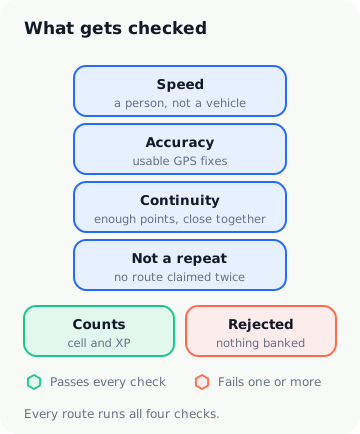
- Speed. A route has to move at speeds a person moves at. Anything implying a vehicle is thrown out.
- Accuracy. Individual positions that are too imprecise are dropped, and a route made mostly of poor fixes is rejected rather than guessed at.
- Continuity. A route needs enough positions, close enough together in time, to describe someone actually travelling. A jump across town does not pass.
- Not a repeat. Each route reduces to a fingerprint. Submitting the same movement twice is caught, as is a route overlapping one already counted.
The signal score
Every finished session gets a score out of 100 for how clean its GPS was, along with the reasons behind it. Steady accuracy, a realistic pace and a good density of positions push it up. Weak signal, sparse positions or a speed spike pull it down, and the summary names which applied.
The score is feedback rather than a gate. It does not change your XP, does not decide whether a cell is claimed, and does not affect anything you hold. It is there so you can tell the difference between a quiet session and a phone that had a bad time in a tunnel.
Over several sessions those scores build into a readiness view, which is a trend line rather than a verdict.
Your coordinates are not stored
This is the part worth being exact about.
While a session runs, your positions live in memory on your device. They are used for two things: working out whether the movement was plausible, and working out which cells you crossed. When you leave the summary they are gone.
What is kept afterwards is the distance, the duration, which cells you touched, the signal score and its reasons. No latitude or longitude is written down at any point, so there is no history of where you went for anyone to read, lose or hand over. The fingerprint used to catch repeats is derived from the route and cannot be turned back into one.
The same rule holds everywhere else in the app. Cell names are invented rather than looked up, districts are assigned by identifier rather than by location, and the weekly recap is built from counts. Nothing in MovenRun resolves your position to a real address, neighbourhood or landmark.
Where the checking runs
Today the checks run on your device, which is also why everything above stays there. A server-side version of the same pipeline is built and is planned to run alongside it, so that what counts toward a shared map is verified somewhere a device cannot influence. It is not connected to the app yet.